NewThoughtLibrary.com
presents Thought Forms by Annie Besant, along with mp3's, eBooks and more...
Thought Forms Annie Besant
More New Thought Resources:









New Thought Library is an online public library with free eBook and audio downloads.
"Unlike so many, we do not peddle the Divine word for profit."
~ 2 Corinthians 2:17

Serving New Thought is pleased to present
Thought Forms
"Evolution is better than Revolution. New Thought Library's New Thought Archives encompass a full range of New Thought media from Abrahamic to Vedic reflecting the ongoing evolution of human thought. New Thought's unique inclusion of science, art and philosophy contrasts with 'old thought' Religion. Today's 'New Thought 3.0' teaches personal responsibility, self-development, human rights and compassionate action as essential spiritual paradigms." ~ Avalon de Rossett
Contents - Foreword - Introduction - Difficulty Of Representation - Two Effects Of Thought - How The Vibration Acts - Form And Its Effect - Meaning of the Colour - Three Classes Of Thought-Forms - Illustrative Thought-Forms / Affection - Devotion - Intellect + Ambition - Anger - Sympathy - Fear - Greed - Various Emotions - Forms Seen in Those Meditating - Helpful Thoughts - Forms Built By Music - Mendelssohn - Gounod - Wagner
This library should make your reading, research and writing projects easier. Fully processed books have yellow page scan links to check text accuracy. File numbers for .jpg and .htm files etc... match the original page numbers for accuracy and ease of use. This enables writers to create reference links for research or publication. Use it, send in additions and keep in mind that your support means more free books, better processing and more downloads.

Intellect
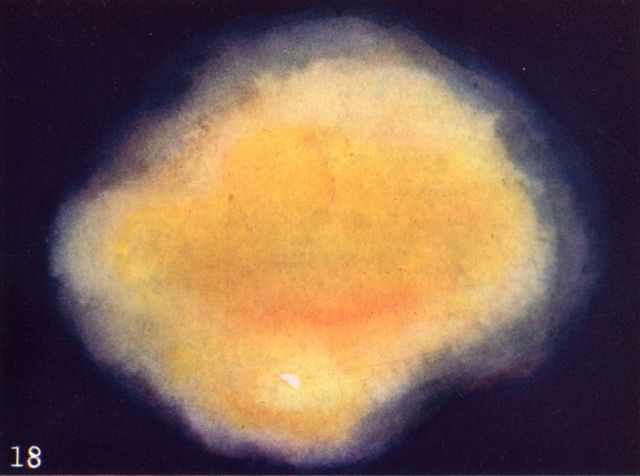
Vague Intellectual Pleasure.—Fig. 18 represents a vague cloud of the same order as those shown in Figs. 8 and 14, but in this case the colour is yellow instead of crimson or blue. Yellow in any of man's vehicles always indicates intellectual capacity, but its shades vary very much, and it may be complicated by the admixture of other hues. Generally speaking, it has a deeper and duller tint if the intellect is directed chiefly into lower channels, more especially if the objects are selfish. In the astral or mental body of the average man of business it would show itself as yellow ochre, while pure intellect devoted to the study of philosophy or mathematics appears frequently to be golden, and this rises gradually to a beautiful clear and luminous lemon or primrose yellow when a powerful intellect is being employed absolutely unselfishly for the benefit of humanity. Most yellow thought-forms are clearly outlined, and a vague cloud of this colour is comparatively rare. It indicates intellectual pleasure—appreciation of the result of ingenuity, or the delight felt in clever workmanship. Such pleasure as the ordinary man derives from the contemplation of a picture usually depends chiefly upon the emotions of admiration, affection, or pity which it arouses within him, or sometimes, if it pourtrays a scene with which he is familiar, its charm consists in its power to awaken the memory of past joys. An artist, however, may derive from a picture a pleasure of an entirely different character, based upon his recognition of the excellence of the work, and of the ingenuity which has been exercised in producing certain results. Such pure intellectual gratification shows itself in a yellow cloud; and the same effect may be produced by delight in musical ingenuity, or the subtleties of argument. A cloud of this nature betokens the entire absence of any personal emotion, for if that were present it would inevitably tinge the yellow with its own appropriate colour.
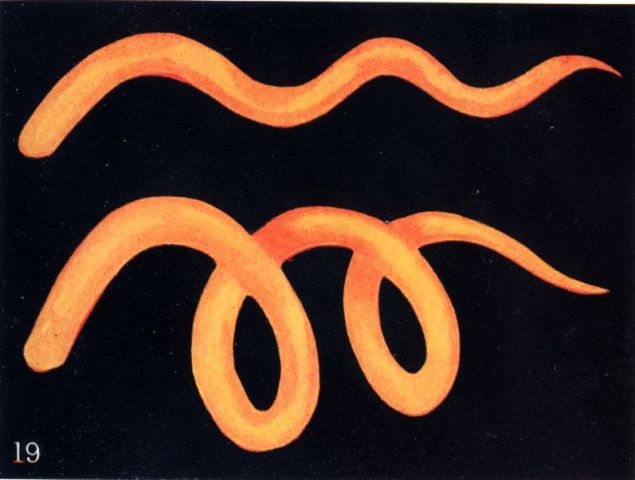
The Intention to Know.—Fig. 19 is of interest as showing us something of the growth of a thought-form. The earlier stage, which is indicated by the upper form, is not uncommon, and indicates the determination to solve some problem—the intention to know and to understand. Sometimes a theosophical lecturer sees many of these yellow serpentine forms projecting towards him from his audience, and welcomes them as a token that his hearers are following his arguments intelligently, and have an earnest desire to understand and to know more. A form of this kind frequently accompanies a question, and if, as is sometimes unfortunately the case, the question is put less with the genuine desire for knowledge than for the purpose of exhibiting the acumen of the questioner, the form is strongly tinged with the deep orange that indicates conceit. It was at a theosophical meeting that this special shape was encountered, and it accompanied a question which showed considerable thought and penetration. The answer at first given was not thoroughly satisfactory to the inquirer, who seems to have received the impression that his problem was being evaded by the lecturer. His resolution to obtain a full and thorough answer to his inquiry became more determined than ever, and his thought-form deepened in colour and changed into the second of the two shapes, resembling a cork-screw even more closely than before. Forms similar to these are constantly created by ordinary idle and frivolous curiosity, but as there is no intellect involved in that case the colour is no longer yellow, but usually closely resembles that of decaying meat, somewhat like that shown in Fig. 29 as expressing a drunken man's craving for alcohol.
High Ambition.—Fig. 20 gives us another manifestation of desire—the ambition for place or power. The ambitious quality is shown by the rich deep orange colour, and the desire by the hooked extensions which precede the form as it moves. The thought is a good and pure one of its kind, for if there were anything base or selfish in the desire it would inevitably show itself in the darkening of the clear orange hue by dull reds, browns, or greys. If this man coveted place or power, it was not for his own sake, but from the conviction that he could do the work well and truly, and to the advantage of his fellow-men.

Selfish Ambition.—Ambition of a lower type is represented in Fig. 21. Not only have we here a large stain of the dull brown-grey of selfishness, but there is also a considerable difference in the form, though it appears to possess equal definiteness of outline. Fig. 20 is rising steadily onward towards a definite object, for it will be observed that the central part of it is as definitely a projectile as Fig. 10. Fig. 21, on the other hand, is a floating form, and is strongly indicative of general acquisitiveness—the ambition to grasp for the self everything that is within sight.


PREVIOUS PAGE - 9 - NEXT PAGE


Links to Additional Media for Thought Forms by Annie Besant such as audio and ebooks are located at the bottom of this web page.
FindACenter.com
Discover a rainbow of exciting New Thought Communities around the corner and around the globe.
Find FellowshipDivine Journal
Daily Wisdom from today's New Thought Leaders supports your Spiritual Journey with insights and affirmations.
Daily WisdomNew Thought Talks
Interviews with New Thought Sharers around the world & explorations of current themes in New Thought
New Thought Talks-

NewThought.NET/work
Manifest Your Dreams
Processing credits for Thought Forms by Annie Besant"Together we make a difference."
This is Ancient Wisdom.
"Diversity is strength!"
Register NOW
NewThought.NET/work = the Power of WE -
NewThought.NET/work
Manifest Your Dreams
Processing credits for Thought Forms by Annie BesantNew Thought Leaders "are life long learners"
Learn the hidden wisdom.
Library patrons support the library and get first notices and more ...
Register NOW
NewThought.NET/work = the Power of WE
Great New Thought Resources:










A Powerful Collection of Spiritual Resources
We give you a powerful platform upon which to do God's Work learning and sharing New Thought:
DivineJournal.com, NewThoughtCommunity.com, NewThoughtTao.com and many more ...
Use DivineJournal.com to Research, read & write New Thought Texts which you can share through NewThoughtBook.info.
New Thought Resources accessible to anyone in the world with an internet connection.
Find New Thought Communities around the corner & around the world.
FindACenter.com, NewThoughtCentres.com, NewThoughtCenters.com
Celebrating New Thought Diversity in thought and form, we weather all storms, thrive and prosper! NewThoughtDay.com, NewThoughtWeek.com
New Thought Holidays
New Thought Day was declared by James Edgerton on August 23rd, 1915
During research while expanding the free New Thought Library,
one of the ministers came across an interesting quote from early New Thought Alliance President James A. Edgerton:
"'The truth, once announced, has the power not only to renew but to extend itself.
New Thought is universal in its ideals and therefore should be universal in its appeal.
Under the guidance of the spirit, it should grow in good works until it embraces many lands and eventually the whole world.'
~
New Thought Day, August 23rd
, 1915."





NewThought.NET/work Serving New Thought
A growing collection of resources supported by a vast and expanding team of volunteers around the globe.

New Thought Radio
Talks by New Thought Spiritual LeadersUplifting Messages from New Thought Communities around the world.
Listen to New Thought Radio broadcasts from the New Thought Streams PodCast Archive, along with a growing collection of New Thought Music directly from New Thought Artists around the world.
Listen to New Thought Radio 24/7/365
New Thought Day
August 23rd
100 years old
1st declared by James Edgerton in 1915
"'The truth, once announced, has the power not only to renew but to extend itself. New Thought is universal in its ideals and therefore should be universal in its appeal. Under the guidance of the spirit, it should grow in good works until it embraces many lands and eventually the whole world.' ~ James A. Edgerton, New Thought Day, August 23rd, 1915."
New Thought Holidays August 23rd
DivineTao.com ~ since 2003
Be as water, as you are ...The New Thought Tao
Explore the New Thought Tao and discover deeper wisdom. New Thought has many forms, Taoist New Thought brings insights to the table that are not so apparent in Abrahamic forms. While many Abrahamics fight to impose their views on the rest of the world. Taoist New Thought teaches the way of acceptance and understanding. Principles in the New Thought Tao provide powerful processes which serve as keys to deeper happiness and inner peace from the inside out.
Read Divine Tao #8 "Water" Tao #8
New Thought Conferences
Grow and thrive Share your truthNew Thought conferences from various New Thought denominations and organizations are happening all ove rthe world. Whether Old New Thought or New Thought Today, find conference info about New Thought Conferences!.
New Thought Conferences Share
New Thought Solutions
Conscious Ministry Grow and thrive!New Thought Solutions for New Thought Sharers and New Thought Communities. Empowerment programs that awaken us to the co-creative "Power of We." Grow and thrive sharing a rainbow of New Thought wisdom with the world.
New Thought Solutions Thrive!
Books from contemporary New Thought Writers
NewThoughtBook.infoA growing collection of New Thought books from Today's New Thought Leaders. Many New Thought books lack the marketing necessary to get them in front of you, with New Thought Books INFO those writers to find you and you to find those writers...
New Thought Books Read!